
Basics
How does a thermal camera work?
Everything warmer than absolute zero glows in infrared. A thermal camera collects that glow with a germanium lens, measures it with a microbolometer grid and paints the result in false colour.
Updated
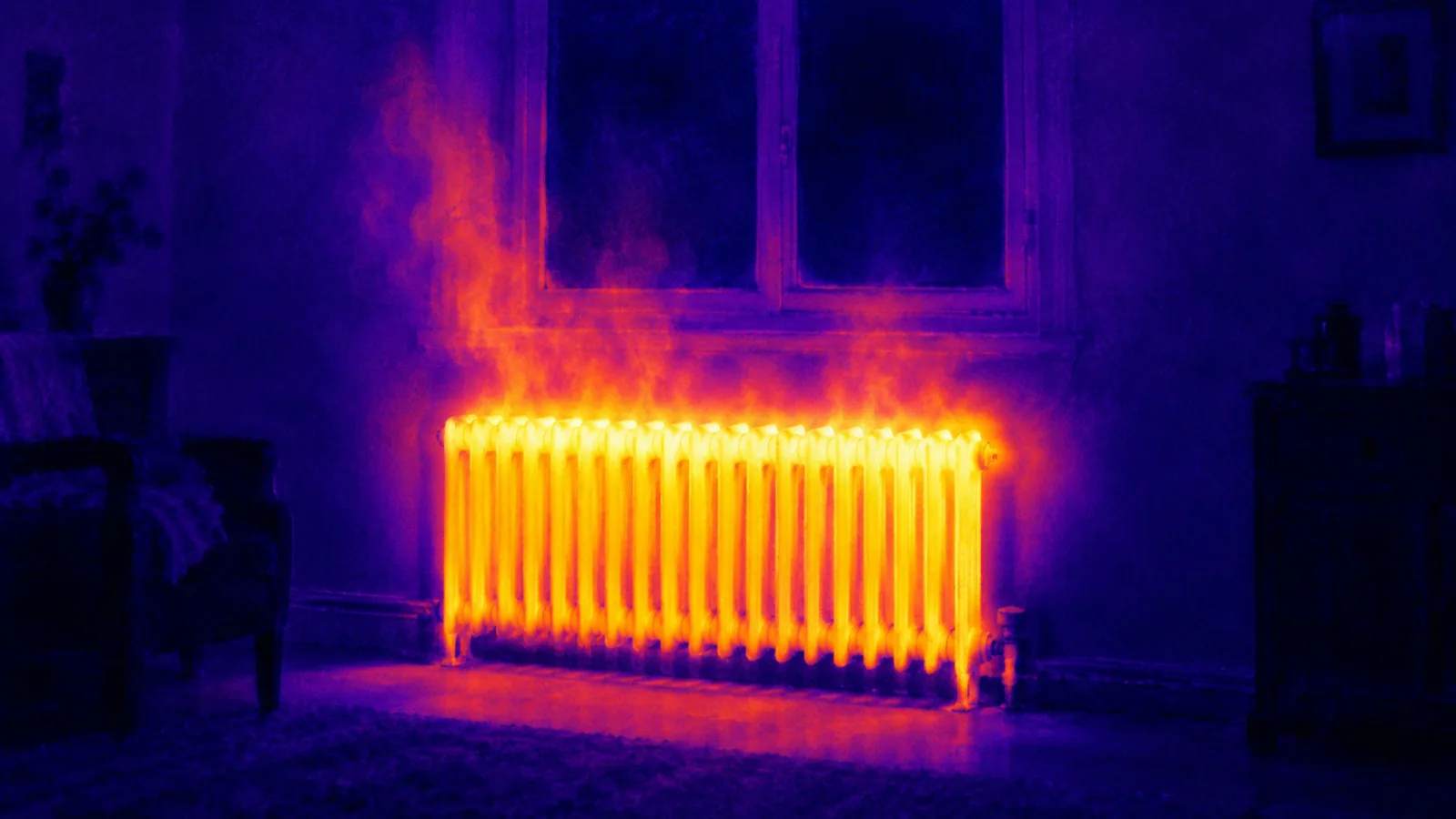
A thermal camera measures the long-wave infrared radiation that every object emits because of its temperature, and turns those measurements into a picture. No lamp, no flash, no ambient light — the subject is its own light source.
Here is the whole chain, one link at a time.
1. Everything glows
Any object above absolute zero radiates electromagnetic energy. How much, and at which wavelengths, depends on its temperature. A star at 5,800 K peaks in visible light. A radiator at 330 K peaks around 9 µm — deep in the infrared, far outside what your eye can see.
Room-temperature scenes emit most of their energy between roughly 8 and 14 micrometres. That window is what thermal cameras are built around, partly because that is where the energy is and partly because the atmosphere happens to be transparent there.
2. A lens made of the wrong stuff
Ordinary glass is opaque at those wavelengths — a glass lens would work about as well as a brick. Thermal optics are made from germanium, sometimes zinc selenide or chalcogenide glass. Germanium looks like polished metal to your eye and is perfectly clear in long-wave infrared.
This is one of the reasons thermal cameras cost what they do, and one of the reasons phones do not have them.
3. The microbolometer
Behind the lens sits a grid of tiny membranes, each one a few tens of micrometres across, suspended on legs so thin they barely touch anything. Infrared lands on a membrane and warms it by a fraction of a degree. That temperature change alters the membrane’s electrical resistance, and the camera reads the resistance.
One membrane, one pixel. A typical handheld imager has 160×120 or 320×240 of them — which is why thermal images look so soft next to a phone photo. And because the sensor itself is a thermometer, the camera has to keep track of its own temperature: that soft mechanical click every few minutes is a shutter closing to give the sensor a uniform reference view. It is called flat-field correction, and without it the image slowly drifts.
Cooled scientific cameras use a completely different detector held near 77 K, which is why they are sensitive enough to see a temperature difference of a hundredth of a degree — and why they cost as much as a car.
4. From temperature to colour
At this point the camera has a grid of numbers, not an image. A palette maps each number to a colour:
- Iron — the classic: black through purple and red into yellow and white. Most people read it instantly.
- White hot / black hot — plain greyscale, either way up. Preferred by thermographers because nothing distracts from the shape.
- Rainbow — maximum contrast between small differences, at the cost of looking psychedelic.
- Arctic, lava, amber — the same trick with a different colour ramp.
None of these colours is real. They are a legend, the way a contour map’s greens and browns are a legend. That is why thermal photographs always carry a scale bar: without it, “yellow” means nothing.
The camera also chooses a range. Map the palette across a wide span and the whole scene is visible but flat; map it narrowly and a half-degree difference fills the screen. Most of the skill in thermography is picking that range.
5. Edge detail
A 160×120 thermal image tells you where the heat is but not what you are looking at. So many cameras add a second, ordinary camera and trace its edges back over the thermal picture — FLIR calls its version MSX. Faces, labels and pipework stay recognisable while the colour keeps carrying the temperature.
What it is actually good for
- Building work. Missing insulation, air leaking round a window, damp inside a wall, underfloor heating runs.
- Electrical inspection. A loose connection heats up long before it fails.
- Mechanical work. Bearings, brakes, over-worked motors.
- Search and wildlife. A warm body against a cold field is unmistakable at night.
What it cannot do
- See through walls. It sees the surface of the wall. A warm pipe inside shows up because it warms the plaster above it, slowly and blurrily.
- See through glass. Glass is opaque in long-wave infrared and mirror-like: point a thermal camera at a window and you photograph yourself.
- Read temperature through anything shiny. Polished metal reflects infrared, so it reads as whatever it is reflecting. Thermographers stick a square of matt tape on and measure that instead.
- Work on a phone without hardware. See does the iPhone have a thermal camera.
And the apps?
An app like ours takes the brightness of the ordinary camera picture and runs it through exactly the palettes described above. The maths of step 4 is real; steps 1 to 3 are not happening, because the sensor is not there. It produces the look — steam, a warm vent, sunlight through a curtain all read convincingly — and it does not produce a measurement.