
Night vision
How do night vision goggles work?
Night vision goggles amplify the little light there is, roughly 20,000 times, using a photocathode, a microchannel plate and a phosphor screen. Thermal imaging is a different technology entirely.
Updated
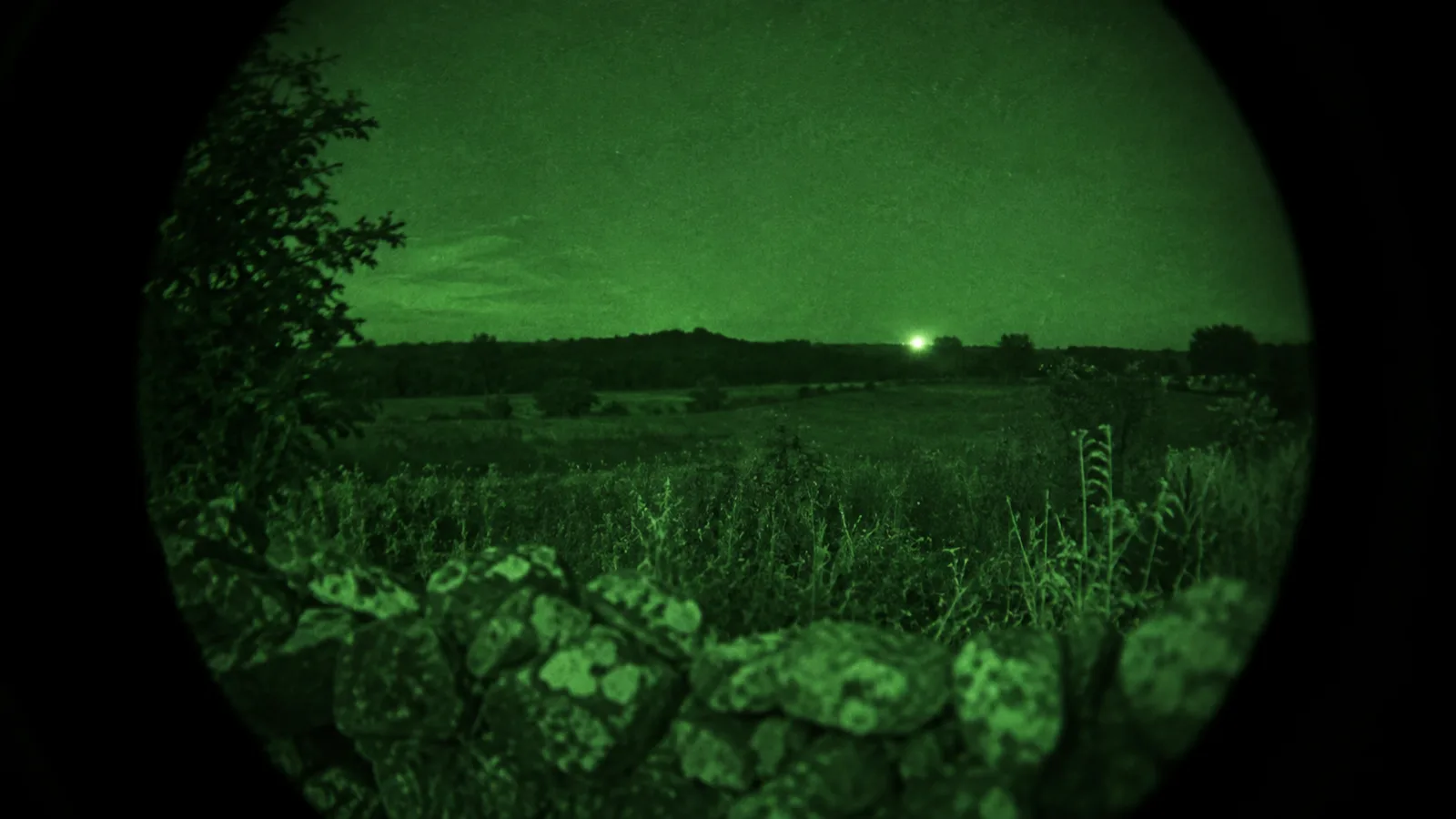
Night vision goggles amplify the small amount of light already present — starlight, moonlight, skyglow — by a factor of tens of thousands, and show you the result on a small phosphor screen. They do not see heat, and they do not work in absolutely zero light without an infrared illuminator.
The three parts
The objective lens gathers whatever light is falling on the scene and focuses it onto the front of the tube.
The image intensifier tube does the work:
- The photocathode converts incoming photons into electrons — a gallium arsenide coating on modern tubes, which is sensitive well into the near infrared as well as visible light.
- The microchannel plate is a glass disc perforated with millions of channels a few microns wide, held at a high voltage. An electron entering a channel bounces off the walls, knocking free more electrons at every bounce. One in, thousands out.
- The phosphor screen converts that electron shower back into visible light. Because the electrons stay in their channels, the image keeps its geometry: what you see matches what is in front of you, pixel for pixel.
The eyepiece magnifies that screen for your eye.
The whole thing runs on a couple of AA batteries and has no shutter, no processor and no lag. What you see is happening now.
Generations, briefly
- Gen 1 — 1960s technology, still sold cheaply. Noticeable distortion at the edges, visible noise, short tube life, and usually an infrared LED to make up the difference.
- Gen 2 — introduces the microchannel plate. Much brighter, much cleaner, usable under starlight.
- Gen 3 — gallium arsenide photocathode and an ion barrier film. The standard for military use for decades; tube life in the thousands of hours.
- Gen 3 filmless / Gen 4 / “white phosphor” — thinner or absent ion barrier, better signal-to-noise, often a white-grey screen instead of green.
The numbers describe the tube, not the housing. A “Gen 3” advertised without a figure of merit is marketing.
What they cannot do
Total darkness. Under a mountain, in a windowless basement, inside a sealed container, there are no photons to amplify. Every device that claims to work there is either using an infrared illuminator or is thermal.
See through fog or smoke. Tiny particles scatter visible and near-infrared light. Thermal does much better here, because long-wave infrared passes through smoke with far less scattering.
Handle bright light. Point a tube at a street lamp and the whole image blooms; do it for long enough on older hardware and you damage the tube. Modern tubes protect themselves by cutting the gain, which is why the picture dims when a car goes past.
Night vision or thermal?
They answer different questions.
| Night vision (intensifier) | Thermal imager | |
|---|---|---|
| What it senses | Visible + near-infrared light | Long-wave infrared (heat) |
| Needs some light? | Yes | No |
| Through smoke or fog | Poorly | Well |
| Through glass | Yes | No |
| Detail and readability | High — looks like a scene | Low — looks like a heat map |
| Identifies a face | Yes | Rarely |
Which is why professionals carry both, and why a fused device that overlays the two exists at all. If you want the physics of the second column, read how does a thermal camera work.
And on a phone?
Neither, honestly. A phone camera cannot multiply photons and has no microbolometer. What it can do is push the sensitivity of a very good sensor, brighten the shadows and tint the result — which in a dim room genuinely helps you see more than your naked eye does, and in a dark one does nothing at all.
The night-vision looks in Thermal Camera are exactly that: a live green or amber phosphor treatment on the camera picture, with the grain and vignette that come with it. A convincing look, on purpose, and never a claim to be a tube.